
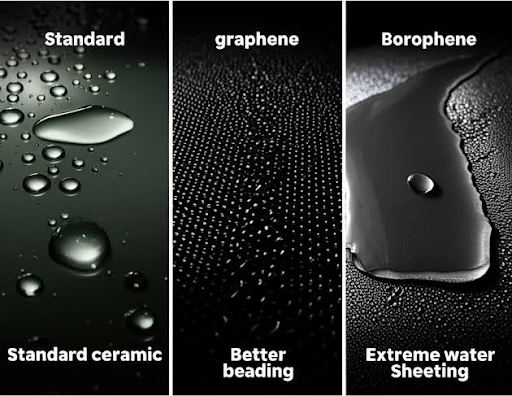
Paint protection has become a little more complicated than it used to be. A few years ago, most car owners were choosing between wax and polish. Today, there are ceramic, graphene, and borophene-based coatings, along with Paint Protection Film for those who want a physical layer between their paint and the road.
That variety is useful, but it can also make the decision confusing. If you are already considering PPF film, does the coating you put over the paint matter? And among ceramic, graphene, and borophene options, which one makes the most sense?
There isn’t one answer for every car. The better choice depends on what you expect from the coating and how the vehicle is used.
What Does PPF Actually Do?
It is useful to distinguish between the roles of the two materials before comparing them.
PPF stands for Paint Protection Film. It is a transparent film that goes directly onto the painted panels. The primary role of the material is the protection of its surface. A decent quality film is able to withstand an impact caused by small stones and other debris, which may lead to chipping or scratching.
It works especially well around the front bumper, hood, fenders, and ORVMs.
The application of coatings is different from that of PPF. The material is much lighter in weight and does not provide the same level of impact protection. The primary functions of coatings include surface protection, water repellency, and glossiness.
That is the reason why PPF and coatings are used together instead of being seen as competitors.
Where Does Ceramic Coating Fit?
Ceramic coating is the most established option among the three.
Most automotive ceramic coatings use silica-based chemistry that cures into a hard, transparent layer over the clear coat. Once properly applied, the surface becomes highly water-repellent and less likely to hold onto dirt.
For everyday driving, that makes a noticeable difference. Washing becomes easier, water runs off more readily, and contaminants have less opportunity to remain on the paint.
Ceramic is also a familiar technology, which means there is plenty of experience around application and maintenance.
If you want a straightforward, proven coating to complement PPF film, ceramic remains a sensible starting point.
What Graphene Coating Brings to the Table?
Graphene coatings are generally presented as an evolution of conventional ceramic formulations. Graphene is a carbon-based material with notable strength and thermal properties, and some coating manufacturers incorporate it into their formulations to modify the behavior of the finished surface.
Owners are often drawn to graphene coatings because of their slick feel, water behavior, and claims surrounding heat management.
That doesn’t mean every graphene coating will outperform every ceramic coating. Formulations differ widely between products, and the preparation underneath the coating remains critical.
When used alongside PPF, a graphene-based coating can be useful where the goal is easier cleaning and a smooth, glossy finish across the film and exposed painted surfaces, provided the products are compatible.
Role of Brophene coating
Borophene is a much newer name in the automotive detailing conversation.
The material itself has attracted considerable interest in scientific research because of its unusual properties at the nanoscale. Automotive products marketed as borophene coatings aim to translate some of those material characteristics into surface protection.
However, this is an area where buyers should be particularly careful with marketing claims. Not all products labeled as borophene coatings necessarily use identical formulations, and long-term real-world data is less established than it is for conventional ceramic products.
For someone interested in trying newer coating technology, borophene may be worth investigating. But it makes sense to examine the actual product specifications, warranty, and installer reputation rather than choosing it simply because the technology sounds more advanced.
Which Coating Works Best With PPF?
If the goal is a combination that is easy to understand and maintain, ceramic coating has the advantage of familiarity.
Graphene may appeal to owners looking for a newer formulation with a particularly slick surface and additional thermal characteristics.
Borophene is the more experimental choice of the three. It can be interesting for enthusiasts who want to explore newer surface-protection technologies, but product quality matters enormously.
The important point is that PPF film remains responsible for the heavy lifting when it comes to impact protection. The coating is there to complement the film, not replace it.
Conclusion
The ceramic vs graphene vs borophene coating debate is less about finding one universal winner and more about choosing the characteristics that suit your car.
For physical protection, however, PPF film remains the stronger solution. Pairing quality PPF with a compatible coating can give owners the best of both worlds: a barrier against road damage and a surface that is easier to clean and maintain.
The smartest investment is therefore not necessarily the coating with the newest name. It is the combination that fits the vehicle, driving conditions, maintenance habits, and quality of installation.