
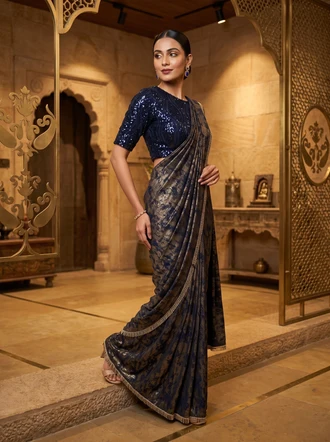
Anyone who’s spent twenty frustrated minutes trying to plait a traditional sari before a wedding knows exactly why ready-to-wear versions have become such a quiet revolution in ethnic fashion. But there’s a common misconception that convenience comes at the cost of craftsmanship, that a ready made saree is somehow a simplified, lesser version of the real thing. In reality, a well-constructed ready-to-wear sari often involves more technical skill than a traditional drape, not less, since the entire garment has to be engineered to look effortlessly draped while actually being pre-stitched into a stable, wearable structure.
Why Traditional Draping Became a Barrier
The traditional sari, typically five to six metres of unstitched fabric, has always required skill and practice to drape well. For generations, this wasn’t a problem; draping was a learned skill passed down within families and communities. But for many women today, particularly those living outside India without easy access to someone experienced in draping, or simply juggling limited time before an event, the traditional method became a genuine barrier to wearing a garment they otherwise loved. Ready-to-wear sarees emerged directly in response to this gap, preserving the sari’s visual identity while removing the skill and time barrier that kept many women from wearing it confidently.
The Engineering Behind a Pre-Stitched Drape
Creating a ready-to-wear sari that looks authentically draped, rather than like a costume approximation, requires careful construction work. The pleats at the front, traditionally hand-folded fresh for every wear, are pre-sewn into a fixed, symmetrical fan shape that holds its form throughout the day without loosening. The pallu, the decorative portion draped over the shoulder, is similarly pre-set to fall at the correct angle and length. Achieving this requires precise measurement and construction, since a pleat set even slightly off-grain can throw off the entire garment’s drape and movement.
Fit: Where Ready-to-Wear Sarees Differ Most From Traditional Ones
Fit is arguably the single biggest advantage a ready made saree offers over traditional drapes. A traditional sari’s fit depends entirely on the wearer’s draping skill on any given day, which means the same sari can look dramatically different depending on who drapes it and how much time they have. A ready-made sari, by contrast, is constructed to a specific body measurement from the outset, much like a fitted Western dress, offering consistent, predictable fit every time it’s worn. This is particularly valuable for formal events, where there’s no room for a pleat to come loose or a drape to shift awkwardly partway through the evening.
Fabric Considerations In Ready-to-Wear Construction
Not every fabric behaves the same way once it’s cut and stitched into a pre-set drape, which makes fabric selection a critical part of ready-to-wear construction. Structured fabrics like silk and brocade hold pre-set pleats particularly well, maintaining their shape throughout wear.
Softer, more fluid fabrics like georgette and chiffon require additional internal stitching and sometimes lightweight lining to prevent the drape from collapsing or losing its defined shape over the course of an event. Skilled construction accounts for these fabric-specific behaviors rather than applying the same stitching technique universally across different materials.
Construction Techniques That Preserve Authenticity
A few specific techniques separate genuinely well-made ready-to-wear sarees from mass-produced approximations:
- Precision pleat stitching, ensuring pleats sit at a consistent width and fall symmetrically rather than appearing uneven.
- Internal structuring, using hidden stitching or light boning in the waist area to maintain shape without adding visible bulk.
- Pallu weighting, often using small internal weights or careful fabric layering to ensure the pallu falls and moves naturally rather than looking stiff.
- Seam finishing that mimics traditional draping lines, so the final silhouette reads as authentically sari-like rather than as a simplified reinterpretation.
Understanding Related Ready-to-Wear Styles
It’s worth noting that “ready-to-wear” ethnic wear covers more than just pre-draped sarees. A related, distinct garment worth understanding is the half saree, a traditional South Indian three-piece outfit typically worn by young girls and teenagers, consisting of a long skirt, a fitted blouse, and a separate scarf draped sari-style across the body.
While visually reminiscent of a sari, the half saree is constructed quite differently, built around a skirt base rather than a single draped length of fabric, making it a popular transitional garment for younger wearers before they move into wearing a full traditional sari.
Why Construction Quality Affects Longevity
Beyond appearance, construction quality directly affects how well a ready-to-wear sari holds up over repeated wear. Poorly stitched pleats loosen and lose their shape after just a few outings, while well-constructed garments maintain their drape and structure across years of occasional formal wear. This is particularly important for pieces meant for special, memorable events, weddings, festive celebrations, formal galas, where the garment needs to look as polished at the end of a long evening as it did at the start.
Shopping With Construction Quality in Mind
For shoppers evaluating options, particularly those browsing a Germany-based saree online shop, a few practical checks help assess construction quality before purchasing: examining pleat uniformity in product photos, checking fabric weight and lining details in the product description, and reviewing sizing charts carefully, since a well-constructed ready-to-wear sari still depends on accurate measurements to fit and drape correctly.
Conclusion
The craftsmanship behind a genuinely well-made ready-to-wear sari is easy to underestimate, precisely because its entire purpose is to look effortless. Precise pleat construction, fabric-appropriate stitching, and considered fit all work together to preserve the sari’s traditional elegance while making it genuinely accessible for modern, time-pressed wearers. For anyone browsing a saree online shop in Germany for their next formal occasion, understanding these construction details makes it far easier to recognize genuine quality beneath the convenience.
Riwaaz applies exactly this level of construction care to its ready-to-wear sari collection, working with skilled artisans to ensure pleats, pallu, and fit all hold their shape well beyond a single wear. Their curated range gives shoppers across Germany a reliable way to access authentically crafted sarees without needing to master traditional draping themselves.